Nic
All My Puny SorrowsNic, the medical scientist who lives with Elfrieda Von Riesen in Winnipeg, is both her devoted partner and one of the people most persistently drawn into the work of keeping her safe. His precision and practical habits offer a striking contrast to the uncertainty of Elfrieda’s illness: he plans, researches, and tries to organize care, even when no arrangement can guarantee the outcome. After her death, his insistence on respecting her wishes extends that care into the choices surrounding her ashes and burial.
Identity and Life with Elfrieda
Nic enters Yolandi Von Riesen’s account after Elfrieda has slowly regained her health, begun playing piano and performing concerts again, and met a man who adores her. They live together in Winnipeg, a city the narration describes in extravagant, contradictory terms: cold yet hot, distant from the sun yet bright, where two rivers meet. The portrait places Nic within the everyday life Elfrieda has made there, while making clear that her earlier illness remains part of the history of their relationship.
Nic is characterized as exacting about practical details. He trusts textbooks, manuals, recipes, and fixed sizes, and dislikes imprecise categories. That temperament does not mean he cannot welcome uncertainty: Elfrieda’s suggestion that he play around the notes delights him. His response makes their difference a source of pleasure rather than simply a conflict. She makes unusual requests; he enjoys them, and each becomes a small occasion for him.
His non-Mennonite identity matters to Elfrieda, who has had painful experiences with Mennonite men and their efforts to impose shame and religious expectations. Nic’s medical work is described with some uncertainty by Yolandi, who thinks he may be trying to eliminate stomach parasites. Lottie, by contrast, tells friends that he is working on a cure for diarrhea, while expressing skepticism about cures and challenging the reach of scientific explanation with her claims of communicating with the dead. The contrast gives Nic a place in a family where practical science and other accounts of experience coexist, sometimes uneasily.
Partnership and the Work of Care
The novel presents Nic’s attachment through sustained acts of attention rather than declarations. When Elfrieda stops eating and begs her family not to call a doctor, Nic and Lottie are desperate enough to ask Yolandi to come. Yolandi goes to Elfrieda’s bedroom and decides to call for medical help despite Elfrieda’s pleading. The sisters recognize the divide plainly: Elfrieda wants to die, while Yolandi wants her to live, and their love does not spare them from becoming opponents in the immediate decision. Nic is part of the family crisis surrounding that choice, even as Yolandi’s account focuses on the sisters’ encounter.
As Elfrieda is hospitalized, Nic visits her after work. He and Yolandi meet afterward to discuss what to do next, trying to assemble a team of caregivers for Elfrieda’s eventual release. The plan proves difficult to secure. Nic cannot reach most of the prospective team; one social worker is unsure that funding remains available. When Nic offers to pay himself, the worker cannot confirm that private payment will solve the problem. The exchange exposes the gap between the family’s urgent need for supervision and the uncertain resources available to provide it.
Nic continues to search for a workable response even as he recognizes its limits. He talks with Yolandi about a kayak he is building and expects to take onto the river by May, down to the bolts that must be mailed from Minneapolis. Yolandi questions whether keeping Elfrieda watched every moment is futile; Nic agrees that it may be, but sees no obvious alternative. His plans for the kayak and his efforts to arrange care sit side by side: ordinary future-making continues while the family tries to manage a danger it cannot fully control.
Hospital Crises and Uncertain Communication
When Elfrieda is expected to leave the hospital, Yolandi realizes that Nic has not yet been told. She calls him, and he is surprised by the news. He responds by agreeing to contact the care team immediately, leaving work early, buying groceries, and meeting the family at home. His readiness to act is practical, but the sudden discharge leaves little time for the careful support the family had been trying to arrange. Yolandi suspects Elfrieda may be released if she tells staff that she feels well and is not suicidal; the family’s hope and apprehension therefore accompany the same trip home.
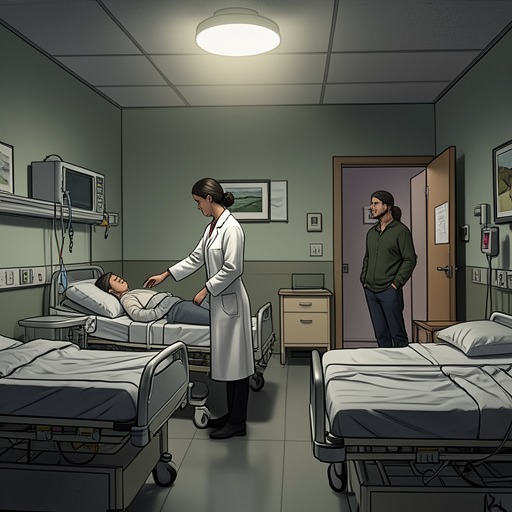
Another crisis brings Nic into the hospital’s uncertainty from a different direction. He speaks with a doctor behind the glass beside Elfrieda’s room, one hand against his forehead and the other against the wall. After the doctor leaves, Nic tells Yolandi that Elfrieda is expected to live, though the extent of possible longer-term harm is not yet known. He has received a provisional assessment, not certainty, and must carry that partial information back to the family.
Nic remains with Elfrieda for hours. When Yolandi visits, she finds that he has gone home, angry that a neighbor has spread news of Elfrieda’s ambulance trip and that a reporter has called to ask about her condition. The intrusion brings private suffering into public circulation without giving the family control over what is said. In the room, Elfrieda cannot answer Yolandi because a tube remains in her throat. Nic’s continuing presence and the family’s attempts to speak with her take place amid medical uncertainty and sharply limited communication.
A later disagreement shows that concern for Elfrieda does not give Nic and Yolandi a shared understanding of what communication should require. Nic says that, if Elfrieda wants to get better, she will have to attempt to communicate normally. Yolandi has just heard that Elfrieda would not speak. The exchange leaves a tension between the wish for recovery and the difficulty of treating ordinary speech as the only adequate form of participation. The evidence does not resolve that difference, but it places Nic among those trying to understand how to help when the person they love cannot or will not respond in expected ways.
Separation, Future Plans, and Aftermath
When Elfrieda asks Yolandi to take her to Switzerland, Yolandi refuses. Nic’s position in the episode is not described, and the account does not present him as sharing Yolandi’s decision. Later, when Yolandi considers bringing Elfrieda to Toronto, she checks with Nic before making plans. Elfrieda’s money is in a joint account with him, and Yolandi does not want a large withdrawal to go unexplained. Nic says that if Elfrieda wants to go, she can; he does not demand details. He is uncertain that Elfrieda would enjoy a boat, the idea Yolandi has become absorbed in, but remains open to the possibility.
Before Yolandi and Lottie leave for Vancouver for Tina’s funeral, Yolandi speaks to Elfrieda about the prospect of staying with her in Toronto and tells her that she will return. Elfrieda does not speak. The proposed stay is presented as a temporary change of setting and a chance for the sisters to be together, not as a settled solution. Nic’s willingness to consider the move makes room for the plan, but the narration does not claim that it could have changed Elfrieda’s eventual course.
Nic later recounts one ordinary interval after Elfrieda is discharged: they go home, and she asks him to visit the library for her. He suggests lunch first, and they share a meal that he remembers as normal and pleasant, like sitting across from her in earlier times. He then goes to the nearby library to collect the books she requested. When he returns, the house is empty. The sequence turns on a brief, familiar routine interrupted by her disappearance; Nic’s account preserves the tenderness of the meal without making it a promise of recovery.
After Elfrieda dies, Nic declines Yolandi’s wish to keep some of the ashes in Toronto. He does not want Elfrieda divided, and all her ashes are buried beneath a large tree at Elmwood Cemetery in Winnipeg. Lottie had suggested burial beside the family’s father in East Village, but Nic says Elfrieda had expressly opposed being buried there. He therefore refuses a location that would contradict her stated preference, even though it would have reunited her with family. He also rejects Yolandi’s joking suggestion of burial in the backyard, noting the legal problems. When Yolandi asks about the arrangements, Nic tells her she did everything she could. His final role in the account is thus not to solve the grief or settle the sisters’ earlier conflict, but to care for Elfrieda’s expressed wishes and offer Yolandi reassurance.